
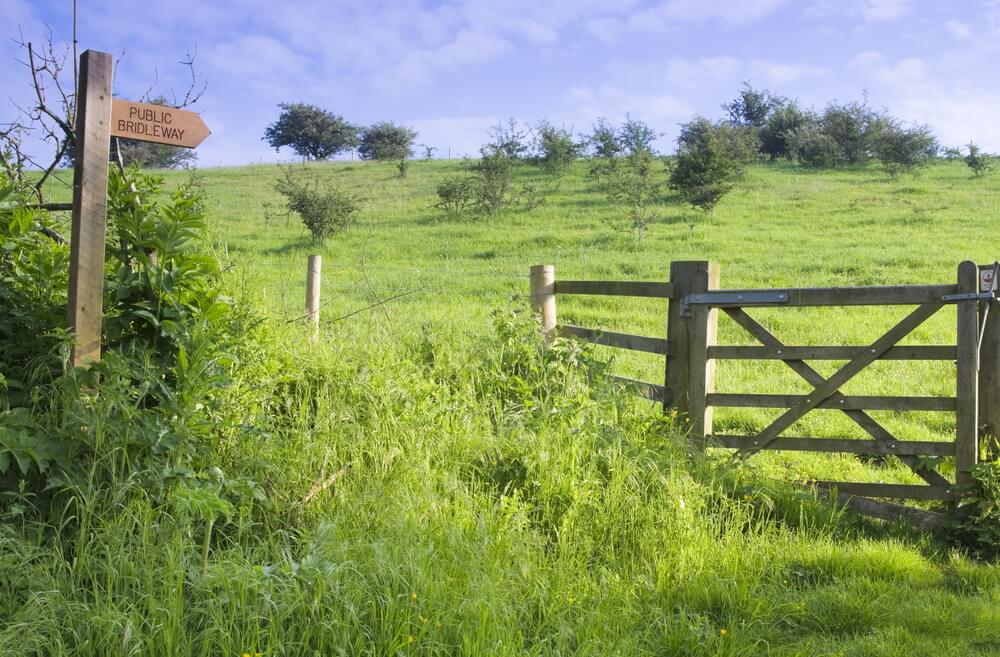
What is a public right of way?
Public rights of way are legally protected routes that allow people to cross land, whether on foot, horseback, or by other permitted means.
A right of way becomes legally protected once it is recorded on a local highway authority’s Definitive Map and Statement. Once a right of way is on this document it is a legally recognised path that must remain open and accessible.
There are four main types of public rights of way in England and Wales:
- Footpaths – designated for pedestrians only. These are the most common type and include many rural and urban walking routes.
- Bridleways – open to pedestrians, horse riders, and cyclists.
- Restricted byways – allow non-motorised traffic, including pedestrians, cyclists, horse riders, and vehicles such as horse-drawn carriages.
- Byways open to all traffic (BOATs) – available to all users, including motor vehicles, though they are often unsurfaced and used mainly by walkers and riders.
Under Section 31 of the Highways Act 1980, a route can also become a public right of way through presumed dedication, often known as the 20-year rule, which we discuss later in this article.
What is a public footpath?
Under Section 66(1) of the Highways Act 1980, a footpath is defined as a highway over which the public has a right of way on foot only. In England and Wales, all legally recognised public footpaths are shown on the Definitive Map and Statement maintained by each local highway authority.
Once a path is added to the Definitive Map, it is considered a public highway and must be kept free from obstruction and made reasonably passable for walkers.
Public footpaths are also normally marked on Ordnance Survey maps, helping walkers navigate the countryside legally and confidently.
It is important to distinguish public footpaths from other types of paths:
- Public footpaths are legally protected rights of way that must remain open and accessible. They give anyone the right to walk the route at any time, regardless of land ownership.
- Permissive paths are routes where a landowner voluntarily allows public access but retains the right to close or restrict access at any time. These are not recorded on the Definitive Map and do not carry the same legal protections.
- Private paths are intended for use only by the landowner or with express permission. There is no public right of access and using them without consent may constitute trespass.
What is the difference between a footpath and a pavement?
As we have discussed above, a footpath is a type of public right of way which is officially recorded on the local highway’s Definitive Map.
A pavement (also called a footway) is different. It is the pedestrian path running alongside a road that forms part of the public highway maintained by the local authority.
Unlike footpaths, pavements are not included on the Definitive Map because they are legally considered part of the public highway (part of the road itself). Their legal status is already established and doesn't need to be separately recorded.
How are roads and rights of way defined in law?
In legal terms, a road is a type of highway, but not all highways are roads. Under Section 328(1) of the Highways Act 1980, a highway is defined as any route over which the public has a right to pass and repass—on foot, by bicycle, on horseback, or in a vehicle—depending on the route's classification.
A public road is a highway primarily intended for vehicles, such as motorways, A-roads, and residential streets. These are usually adopted and maintained by the local highway authority to meet safety standards for surfacing, drainage, and signage.
By contrast, public rights of way (including footpaths, bridleways, restricted byways, and byways open to all traffic) are also highways in law, but are mainly designed for non-vehicular access. For example, a public footpath is legally a highway, but only pedestrian access is allowed.
This distinction matters when determining what kind of access is permitted, who is responsible for maintenance, and how rights of way relate to public roads, especially in rural or mixed-use areas.
What are a landowner’s responsibilities for footpaths across farmland?
A public footpath may cross privately owned farmland. This means the public has a legal right to walk the route at any time, and landowners cannot block, obstruct, or attempt to discourage access in any way.
Obstruction and access – Highways Act 1980, Sections 137 & 137A
It is a criminal offence to obstruct a public right of way. This includes:
- Locking or blocking gates across the path
- Erecting fences or other barriers
- Allowing vegetation or crops to obstruct the path
- Displaying misleading or intimidating signs
Landowners must not obstruct public rights of way, while local authorities have a duty under Section 130 of the Highways Act 1980 to protect public access.
Gates, stiles and maintenance – Highways Act 1980, Section 146
Stiles and gates on footpaths must:
- Be authorised by the local authority
- Be kept in safe condition by the landowner
Authorities may assist with maintenance or upgrade structures for better accessibility. Landowners are not permitted to install or modify stiles or gates without consent.
Livestock and public safety – Wildlife and Countryside Act 1981, Section 59 & Associated Regulations
Farmers may graze animals in fields crossed by public footpaths, but legal safety rules apply.
Under the Wildlife and Countryside Act 1981, Section 59 dairy bulls over 10 months old are prohibited from such fields. Beef bulls may be kept only if they are accompanied by cows or heifers and show no signs of aggression.
Landowners may be liable for injuries caused by livestock under the Animals Act 1971 and the Occupiers’ Liability Act 1957, particularly if they knew an animal posed a risk. Additional safety advice is provided by the Health and Safety Executive (HSE), which recommends risk assessments, appropriate signage, and taking steps to prevent contact between aggressive animals and the public.
Waymarks, diversions and signage – Countryside and Rights of Way Act 2000, Sections 64 & 69
The Countryside and Rights of Way Act 2000 reinforces public access by making it an offence to interfere with official markers or alter public routes unlawfully.
- Landowners must not remove, deface, or obstruct waymarks (official signs or markers used to indicate a public right of way).
- Landowners must not divert, block, or reroute a public right of way on their own without approval from the local authority.
- Signs such as “Private – Keep Out” must not be placed on or near public footpaths, as they can mislead the public and may constitute an offence.
What are the responsibilities of the person using the right of way?
Anyone using a public right of way, including a pedestrian right of way such as a footpath, has a legal right to access the route, but also a responsibility to use it considerately and lawfully.
Walkers must stay on the marked path and avoid straying onto adjacent land, which may be private. Public access does not give permission to picnic, camp, cycle, or drive vehicles on a footpath unless the landowner has specifically allowed it.
Users should follow the Countryside Code, which advises people to:
- Respect property and farmland
- Close gates behind them
- Keep dogs under close control, especially near livestock
- Avoid littering or causing damage to crops and fencing.
If a path is blocked, damaged, or unsafe, users are encouraged to report the problem to the local authority, which is responsible for public rights of way maintenance and enforcement.
What is the 20-year rule for presumed rights of way?
Under Section 31(1) of the Highways Act 1980, a public right of way can be presumed to exist if the public has used a route “as of right”, that is, openly, without force, secrecy, or permission, for a continuous period of 20 years.
To establish a presumed right of way, two key conditions must be met:
- There is clear evidence of uninterrupted public use over 20 years
- The landowner has not taken steps to challenge or prevent that use during the period.
If these criteria are met, a member of the public or organisation can apply to the local authority for a Definitive Map Modification Order (DMMO) to have the route formally recorded as a public right of way.
If the application is disputed, the matter may be decided through a public inquiry or written representations overseen by the Planning Inspectorate.
Do you need legal advice on public rights of way?
Whether you are a landowner facing a claim over a public path, a developer navigating private access rights, or someone looking to assert a public right of way under the 20-year rule, our experienced team at Parkinson Wright Solicitors can help.
With over 40 years’ experience in public rights of way, highways law, and property disputes, we regularly advise clients on interpreting deeds, resolving blocked access, and representing them at public inquiries involving Definitive Map Modification Orders.
Contact us on 01905 814 467 to speak to Douglas Godwin, Partner and Head of Rural Services or a member of our Commercial or Dispute Resolution team or email worcester@parkinsonwright.co.uk